26 February 2016

By What Authority?

The title of this post might imply that it is a review of a book by Msgr. Robert Hugh Benson, who under this title wrote a novel treating of the English Reformation. As interesting as that topic might be, this post will deal with another subject that might equally claim a right to such a title, and that is the present collapse of authority as the means by which a Catholic lays hold of the truth.

In the crisis brought upon the Church by the triumph of Modernism at the Second Vatican Council, Catholics saw a division opening up between the authorities in the Church, such as the Pope or Diocesan bishops, and the content of the Faith itself. Archbishop Lefebvre summarized this conflict by his quote, well known in traditional Catholic circles, that “Satan’s masterstroke is to have succeeded in sowing disobedience to all Tradition through obedience.”  A gulf has opened in the life of Catholics. While the traditional teaching of the Church had before been defended by the hierarchy, the Council manifested a new tendency- to use the virtue of obedience in order to destroy the very Deposit of Faith the defense of which was the very purpose of the hierarchy. Thus, after the Council, Pope Paul VI and the world's bishops proceeded to replace the traditional Magisterium based on Scripture and Tradition with a new Magisterium. The venerable Rite of Mass that enshrined the Faith would now give way to a New Rite, the expression of the centrality of man even when it did not deny the existence of God. The results can be seen around us, liturgies more and more profane in their content, a great confusion as to dogma and whether it has any real power to bind the faithful, and the supreme doctrine of evolution expressed by the various "Magisteria" of each succeeding pope in which doctrinal "progress" replaces eternal and unshakeable truth.

Surely, such a disaster is unprecedented. But in the face of such confusion and heresy, what is to be the final answer? St. Vincent of Lerins posed a like question in the light of the various crises that had afflicted the early Church. His answer must stand even as it did in the fifth century:

"Moreover, in the Catholic Church itself, all possible care must be taken, that we hold that faith which has been believed everywhere, always, by all. For that is truly and in the strictest sense Catholic, which, as the name itself and the reason of the thing declare, comprehends all universally. This rule we shall observe if we follow universality, antiquity, consent. We shall follow universality if we confess that one faith to be true, which the whole Church throughout the world confesses; antiquity, if we in no wise depart from those interpretations which it is manifest were notoriously held by our holy ancestors and fathers; consent, in like manner, if in antiquity itself we adhere to the consentient definitions and determinations of all, or at the least of almost all priests and doctors."

It is of course the case that this Faith rests on Scripture and Tradition; but this same Faith must be transmitted to each generation of Catholics. It is to be found in the Magisterium of the Church, through which the Church teaches the faithful what is or is not to be found in the Deposit of Faith entrusted by Christ to His apostles. But in a crisis, when bishop is against bishop, and questions cannot be easily solved by recourse to the normal authorities, how is one to be sure that one possesses the truth? here St. Vincent provides the answer: recourse to what the Church has always taught, for all revelation ceased with the death of the last apostle, Saint John, and so revealed truth must come to us from the Church's beginning down to our own time. It is this witness of the Church's tradition that must be the voice that enables us to hold on to immemorial truth during the storm of heresy and unbelief.

This Archbishop Lefebvre knew well, for he based his entire programme after the Conciliar disaster on a simple fact: that which was now du jour in the Church would have resulted in his condemnation at the time when he was ordained and consecrated, while the very truths he was required to profess then were now found to be condemned. Over and over he appealed to the voice of the Roman Magisterium, to the ancient rites of the Church against the innovators. He did not appeal to his own episcopal charism; he did not appeal to the voice of his fledgling Society of Saint Pius X; he appealed to the immemorial teaching of the Roman See, to the Magisterium of the past popes and Councils that were now to be discarded by a new Magisterium and New Rite of Mass. It was, in fact, the test of Saint Vincent of Lérins: to be faithful to the immemorial voice of the Church heard before the crisis.

But the great Archbishop Lefebvre has long since left us. His Society, while weathering many storms, is not the barque of St. Peter. The wisdom of the Archbishop has given way to an appeal to authority, but it is the authority of the Society and not Tradition first of all. The faithful have grown tired of always being at variance with modern Rome, and while not giving up altogether, they have striven to sleep in the arms of the Society, trusting that it would be faithful. But to the Society was no promise ever given by Our Lord, and for a Catholic, no total allegiance can ever be given to any created authority- not the Society's Superior General, nor even the present Pope. It is to the voice of the Roman Pontiffs throughout the ages that the sheep must tune their ears, even as did the great Archbishop himself who fought in their name.

But the crisis in the Society has revealed another, more serious one. Some of the faithful have indeed seen that there is a problem: one cannot pretend that any manner of agreement with a Rome that does not believe in its own Magisterium is not worse than hopeless: it is treason. But the motivations are more complex than simple adhesion to truth and rejection of heresy. Distrust of the modernist hierarchy has deepened to a distrust of any authority outside of oneself. While Archbishop Lefebvre appealed to his knowledge of Tradition gained in Rome while a seminarian, the faithful now find in scattered internet articles the basis of their own final say in what constitutes Tradition. The caution of the Archbishop has changed into the unbounded pride of pastor-less sheep. Even some traditional priests have used the crisis to further private opinions as articles of Faith. It is indeed true that there is a sensus fidei that alerts the sheep to the presence of heresy. Such was the case with Nestorius, whose blasphemous claim that Our Lady could not be invoked as "Mother of God" resulted in riots in Constantinople. The faithful did not need to be theologians to sense the presence of the wolf in the bishop's words. But this sensus fidei was never meant to make of each of the faithful either a theologian or the final court of appeal in matters of Faith. Now the laity, without any instruction in dogmatic or moral theology claim equality with those who spent six years or more drinking in the Church's Magisterium and the teaching of the doctors. Is this reasonable or according to the mind of the Church? If it is, it was a great waste to have seminaries at all. Even as Luther, these so-called faithful believe that every truth can be as easily grasped by Joe Six-Pack as by the most learned theologian. There is no appeal to Catholic Tradition, to the works of the Magisterium, to the past theologians. There is only recourse to the divine internet, or to articles in the now infallible Magisterium of the Society, expressed online on Society websites. Perhaps the Archbishop is appealed to as the final court in matters of Faith or morals. But neither the Society nor the saintly Archbishop can claim such a privilege.

The faithful of the "Resistance" had better return to the mind of the Church if it wishes to avoid becoming a cult of the worst kind, in which the ignorant vomit forth their doctrines and opinions as if they were the  elixir of life. We must always bear in mind the rule of Saint Vincent, the doctrine, worship, and law of the Holy Roman Church our mother, while avoiding errors more grave even than those of the Modernists. For if in the end, the final authority is only the self, it makes little difference if the man is called a "modernist" or a "traditionalist"; the god he worships is only another name for himself.

19 February 2016

Brother Kirill, Sister Church...

On February 12th, ecumenists the world over were given the treat of seeing Pope Francis and
Patriarch Kirill meet together on the island of Cuba. This was an event eagerly awaited ever since the Second Vatican Council, for the Russian Orthodox Church was the most important of those bodies within Orthodoxy; vainly had Pope John-Paul II and Pope Benedict XVI hoped that they would be the protagonists in such a meeting. The Patriarch of Moscow would have none of it. Yet at last a pope was to meet with the Russian patriarch. Pope Francis and Patriarch Kirill not only spoke amiably in an informal setting, but the two of them signed a joint declaration. It was the first swallow foretelling a Russian spring and warmer relations between Rome and Moscow.

Nevertheless, save for those who were lost in past memories of flower children and the Summer of Love, the meeting and joint declaration were nothing over which to rejoice. Ecumenical meetings between popes and non-Catholic leaders have hardly been a novelty since the Council; the Conciliar popes have seemed to relish humiliating the Roman Papacy in the name of brotherly love- whether due to a misguided sense of brotherhood or an abhorrence of Roman triumphalism, or both, must be left up to the guess of the reader. In any case, this meeting was symbolic and significant. For those with an acquaintance of Kirill's past, his presence on Cuban soil was indicative. The Patriarch, as a priest was closely involved with the KGB. According to an important defector from the Soviet bloc, he had been an apostle of Liberation theology, that marxist imitation of Christianity that came to demolish the Faith of so many Catholics in Latin America. Pope Francis, on the other hand, has made it clear how much he admired one of his communist professors in University, and a book has been written concerning his successful harbouring of Communists fleeing from the persecution of the Argentine authorities. Cuba was indeed a fitting place for such a meeting. This was not lost on either one, since the following claim is made on Cuba's behalf:

"Our fraternal meeting has taken place in Cuba, at the crossroads of North and South, East and West. It is from this island, the symbol of the hopes of the “New World” and the dramatic events of the history of the twentieth century, that we address our words to all the peoples of Latin America and of the other continents."

One is not sure how Cuba is the symbol of the hopes of the "New World", an island dominated by Communism since the revolution of Fidel Castro. Certainly Cuba has never been the great light of hope. Even in the Spanish Empire, Cuba, while important, was dwarfed by the Viceroyalty of New Spain centred in Mexico. Only for the Soviet Union was Cuba a beacon of hope, for it was the Soviet toehold in the Western Hemisphere.

As outrageous as this flowery language might be, the next paragraph is worse. Latin America's religiosity is praised as the pledge of future glory. Given that millions upon million of Catholics have left the Church in order to join heretical sects, so many in fact that Catholics no longer make up the majority of several Latin American nations, this hope is scandalous. It is only a fitting foundation of the betrayal to come in the rest of the Declaration.

Heresy looms its ugly head in the fourth paragraph. It is claimed that both Catholics and Orthodox profess the Faith of the first Millennium:

"We share the same spiritual Tradition of the first millennium of Christianity. The witnesses of this Tradition are the Most Holy Mother of God, the Virgin Mary, and the saints we venerate.  Among them are innumerable martyrs who have given witness to their faithfulness to Christ and have become the 'seed of Christians'".

How can two opposing versions of Christianity share the same Tradition? Is not the primacy of the pope part of the Deposit of Faith? And what of the Mother of God? Is she looking on as a witness, or is the Catholic and Orthodox veneration of her the same? Did Rome renounce the Immaculate Conception or Moscow suddenly convert to it? What of the nature of marriage? is it indissoluble or not? What of the Filioque of the Creed? Given the next paragraph, one is left wondering why there is any division in the first place...

"Notwithstanding this shared Tradition of the first ten centuries, for nearly one thousand years Catholics and Orthodox have been deprived of communion in the Eucharist. We have been divided by wounds caused by old and recent conflicts, by differences inherited from our ancestors, in the understanding and expression of our faith in God, one in three Persons – Father, Son and Holy Spirit. We are pained by the loss of unity, the outcome of human weakness and of sin, which has occurred despite the priestly prayer of Christ the Saviour: 'So that they may all be one, as you, Father, are in me and I in you … so that they may be one, as we are one” (Jn 17:21).'"

So, the Faith was the same. The whole problem is to be blamed on the politics of our ancestors. it is likewise obvious that to these two, Christ's priestly prayer has gone unanswered. The unity of the Church was lost because of human weakness and sin. A very serious phrase has been included which is meant to explain how these two "Churches" while believing the same, have excluded one another from participation in the Holy Eucharist. The difference lies in the "understanding and expression" of the Faith. The Faith is the same, its expression differs. Even a divergence in the understanding of the Faith does not prevent one from sharing the same Faith. This common Faith, professed in a plurality of ways, will be the basis for the idea of a common evangelization.

It is obvious that an indispensable answer to the disunity of Christians will be found in "dialogue", that incessant process of always learning and never teaching: "Interreligious dialogue is indispensable in our disturbing times. Differences in the understanding of religious truths must not impede people of different faiths to live in peace and harmony. In our current context, religious leaders have the particular responsibility to educate their faithful in a spirit which is respectful of the convictions of those belonging to other religious traditions. Attempts to justify criminal acts with religious slogans are altogether unacceptable. No crime may be committed in God’s name, 'since God is not the God of disorder but of peace' (1 Cor 14:33)." While it might seem good to remind the world that the followers of Christ are law abiding and therefore do not engage in criminal activity, there is a lack of clarity here as well. Totalitarian regimes of one kind or another have not failed to criminalize religious activity, and in this age the danger of such false laws against the Faith is not small. Is it a crime to obey God rather than men? If one means the Divine Law, one can never act against it; but if it is a question of an unjust law of the State, such resistance can become a duty. The presence of relativism in the question of dialogue itself cannot go unnoticed. The difference in religions is in the understanding of religious truths, not in the presence of falsehood in the very doctrines of the religions themselves.

The madness of claiming that Catholicism and Orthodoxy are actually the same religion, divided only by misunderstandings arising from a different mode of expression in confessing the same truth finds a place in the Declaration by the idea of a common evangelization: "Orthodox and Catholics are united not only by the shared Tradition of the Church of the first millennium, but also by the mission to preach the Gospel of Christ in the world today. This mission entails mutual respect for members of the Christian communities and excludes any form of proselytism." So now both have a Divine mission to preach the Gospel. What a mockery of those saints who died rather than deny the pope's primacy of jurisdiction over the Church! This common mission can only be possible if, in fact, the Catholics and Orthodox both are members of the One Church of Christ, for there can be no Divine mission granted to heretics or schismatics to propagate their false religions. There is no other possibility for such a double mission save that of being members of the Same Church. While this document does not make such a claim overtly and clearly, the Declaration can only be read in such a light. This alone makes it savour of heresy, if nothing else does. Yet this is the symbolic meaning of the brotherly meeting. One does not meet and sign agreements with one's enemies. Proselytism is forbidden, for why should any strive to convert the Orthodox to Catholicism if both are members of the same Church? No wonder there is such a point of emphasizing the prayer of Christ that there be unity; the One Church stands divided.

Not all of the Declaration is made of such nonsense. There is a reminder of the persecution of Christians in the Mideast; there is a reminder of the evil of abortion and false ideas concerning the family. But the central theme is clear: neither the Catholic Church nor the Orthodox "Church" can claim to be the One Church of Christ. While both share the same Faith, historical accidents blamed on past misunderstandings keep them apart. The push towards a future unified Church, in the hands of those tarnished with past sympathies to Communism, goes forward. The Pope proceeded on from his meeting to visit Mexico, and while there, could not resist kneeling at the tomb of a bishop well know for his sympathy for Liberation Theology, the Communization of Christianity. let us pray that the Successor of Saint Peter be delivered from the bonds of his Modernism.

08 February 2016

Is the pilot light going out?

"I have compared the Society of St. Pius X to the pilot light on a gas stove. When the gas is turned off, the gas-rings go dead, no cooking can be done and very little heat comes off the pilot light, but so long as one can see the pilot light still lit, one knows that the action will resume as soon as the gas is turned on again. But turning on the gas is not within the power of the pilot light itself." Bishop Richard Williamson, September 1991.

It has been over 20 years since the then Rector of Saint Thomas Aquinas Seminary wrote the above words in one of his letters to friends and benefactors. In those days, few thought that the Society of Saint Pius X was in any real danger; after all, both Pope Paul VI and Pope John-Paul II had striven to destroy the work of Archbishop Lefebvre, hurling the thunderbolts of suspension and then excommunication against that French prelate, with little effect. The Society still remained, and though the saintly Archbishop had died earlier in that year of 1991, there was no serious threat that the defenders of Catholic Tradition would collapse. But the future is rarely easy to predict, and time would reveal a growing desire in the top echelons of the Society for some kind of rapprochement with Rome, the growing discontent with Bishop Williamson's reluctance for such a softening, and his final expulsion from the very Society that had trained him, ordained him priest, and consecrated him bishop. The tool for such an exclusion was at hand when the bishop's ideas on the "holocaust", though widely known for many years by all those in Society headquarters, were revealed to the eyes of the media, much to the chagrin of the Roman authorities.  A showdown was inevitable, as the Society distanced itself from any public criticism of the Jewish problem. Such a controversy would hardly be becoming if one wanted the right hand of fellowship from those who lauded Catholic-Jewish relations. So it was that expulsion was necessary, and timely as well, since it removed a very visible opponent to a Roman deal.

It might have seemed that a mass revolt within the ranks of the Society would be inevitable. Although such a revolt would not occur simply because of theories on the "holocaust", it would hardly be unthinkable that such a flare-up of discontent would arise over a future resolution of tension with Rome. There was some complaining, of course, but there was also a steadfast refusal to stand up on the part of those who might have been expected to defend the course of Archbishop Lefebvre. A few were vocal and then expelled; some groups like the Benedictines in Brazil and the Dominicans of Avrillé found themselves outside the camp; but most of the clergy and laity steadfastly closed their eyes and hid themselves behind the dream of the Society's indefectibility. The Society had shown itself to be faithful to Tradition- indeed it had replaced the modernist authorities in the hearts of the faithful. There was really nothing to fear.

Gone was the idea of the Society being a "pilot light". Indeed, it was now far better organized than in the old days; its priories were much more comfortable; the seminaries were ever so much more "spiritual" (meaning that uncomfortable things such as the loss of millions of souls at the hands of the modernist popes and bishops should not bother the future priests of the Society overly much); the Superior General had discovered that he alone really had the grace of state to make decisions for the Society priests, faithful, and even those religious orders who had fought beside the Archbishop- an amazing discovery on the part of one who held supreme office in a Pious Union! The Pilot light had evolved into being the means of bringing the Church back to her senses. Now the only concern was to find a way to convince the Pope and the bishops to approve the Society and let it join Rome in the desire to help the Church. This could not be done, of course, if the Society's image was one of being a complainer. A re-branding was in order, one which would allow the Society to showcase a more positive image. Its official pronouncements, its magazines, its entire manner of showing itself to the world would be one of accentuating the positive. It was the thought of Pope John XXIII re-vivus.

Of course, as mentioned above, a few of the priests and faithful along with the redoubtable Bishop did not find the new way applaudable. These began to voice their opposition. Newly founded Mass centres were set up, and the "resisting" priests now began to work in a much smaller milieu. Some of these could not live without the presence of the infallible Society, and so proceeded to claim infallibility for themselves, if not in words, at least in action. A cry went up for a new Society to replace the old; after all, the catholicity of the Church had to manifest itself somewhere, and the Society of Saint Pius X had defaulted from its Divine mission. Instead of the Society, there was now the "Resistance". This resistance was all that was left of true Catholicism. To support this new dogmatic identification of Tradition with the "Resistance", a great fight broke out over the possibility of attending Mass at places not "approved" by the "Resistance". One group identified itself as "red-lighter" while others took a "yellow" or "green" light position. One might well ask where the authority arose to make such determinations. It has always been clear that one could not attend the Masses of heretics or schismatics. But were Society priests now in either of those two categories? What would have happened before Vatican II if someone had decided that it was immoral to attend a Mass said by a Jesuit due to the fact that the theologians of the Jesuit Order had betrayed the doctrine of Saint Thomas on grace and predestination? What about the Scotist Franciscans? The most radical branch of the "Resistance" had narrowed down Catholicism to the question of what one thought of the 2012 Declaration of the General Chapter of the Society on a future deal with Rome. This is not to depreciate the dangers of that declaration, but such a declaration did not contain heresy. It is one thing to resist the present direction of the Society, and quite another to invent sins as a result.

No surprising, God has struck at the pride of some of these "resistants". The movement now finds itself hopelessly divided. One cannot help but be sympathetic to the reluctance of Bishop Williamson to lead a hierarchically structured counter-Society. It has proven wise for a number of reasons: there is no likelihood whatsoever that those priests who have proven the most anti-Williamsonian would ever have obeyed him in such an organization; secondly, the only hierarchy that can solve this present crisis is the one Divinely constituted of St. Peter's Successor and the bishops, and this is counter to the pride of the Society-Saviour or the Resistance-Saviours; the insanity of priests and laity who theologize on such topics as whether there could ever be a eucharistic miracle in cases when the host was consecrated at the New Mass only show that pride has overthrown all sense of the Faith. When did Archbishop Lefebvre ever deny the validity of the New Rite per se? The New Mass could be invalid in those cases where there was not proper matter, form, and intention, but that was never presumed to be the case in every New Mass. The New Mass was not held to be intrinsically invalid. Anyone who says differently has conveniently forgotten some facts about the Society while the Archbishop was still alive. Indeed, if one thing has become increasingly clear, it is that the Archbishop has been re-invented by those who hold the most unusual positions, positions not at all those of Archbishop Lefebvre. The radical branch of the Resistance has also given up a belief that the hierarchical Church still exists. This is logical, given the fact that adherence to the positions of certain resistance priests has become the mark of the true believer. The Conciliar Church has finally been identified with the "official Church". This being the case, the hierarchy has left the Church. Pride has led to heresy, for the true Church must be hierarchical in the real sense, that is, it must exist with bishops who hold ordinary jurisdiction. Without that, the Church ceases to be Apostolic.

Should we then despair of the situation? Certainly not. The breakdown within Tradition is not a sign that Christ's promises have failed, but quite the contrary. It shows that on the one hand, the Church can never be anything else than what Christ founded it to be- the sole means to salvation, even in this corrupt time.  Christ will not substitute anything else for the Pope and bishops. If He permitted this present disaster, it is only to be a temporary thing until He decides when the Church recovers.  The Society was a providential consequence of Christ's refusal to allow the entire Church to succumb to error. It was only to be a pilot light however, only to last for a little while. Secondly, as this collapse of both the Society and the Resistance continues, this only shows that Christ's triumph is at the door. The Fifth Age is closing, and the Sixth Age, the most glorious Age is near at hand.
"In the end, my Immaculate Heart will triumph" points the way towards the Age that is to come.

27 July 2013

Bishop Fellay and the Grace of State

As the battle presently waging between the adherents of Bishop Fellay and those who have been dubbed "the resistance" shows no signs of ending, it might be (and indeed is) useful to examine an argument that has gained more and more currency among the followers of the SSPX so as to justify their current position and at the same time silence their opponents. This argument might be reduced to this: Bishop Fellay, as the Superior General of the Society of Saint Pius X, has been given the grace of state so as to be able to make any decisions regarding an approval of the Society by the Holy See. Given this special grace, it is in fact disobedience to deny the rectitude of such an accord, or even to question it in any way. The adherents of this position have gone as far as to accuse the "resisters" of following down the path of Luther and the protestant reformers. Thus, we see the resistance labelled a sect for its lack of submission to the legitimate authority of Bishop Fellay and the other superiors of the Society. Sacraments are at times refused to these resisters, not to mention children of resisting parents being threatened with expulsion from Society schools- and not merely threatened. Many aspects of the Society's present position might be examined as to its correctness, but rather than shoot at any and all possible targets, this writer will look more closely at the one underlying many of the actions and attitudes of the Society leadership, namely the question of whether Bishop Fellay possesses a grace of state, and following upon that, to what extent this grace may be relied upon by the faithful as a sure guide of the rectitude of Bishop Fellay's actions.

Firstly, then, we examine the idea of a "grace of state". We know that God gives to each of the faithful special graces that correspond to his duty of state. The existence of a grace particular to ones state is closely allied to the dogma of Divine Providence. God, by His Providence, places us in a position whereby we have certain daily duties that we must perform. Sanctity will only be possible if we submit to what God wishes for us, and this is manifested on one level by the circumstances that He places us in. Thus, a mother of a family does not have the grace to be a nun, because her duty is specific to her role as wife and mother. It is not unheard of, unfortunately, that using the excuse that Saint X., who was a nun and saint, spent many hours a day in devout contemplation before the Blessed Sacrament, must be imitated by Mrs. Z. who has a number of neglected children needing to be taken care of. Mothers therefore, who shirk their duty to change their babies' diapers or feed children and husband so as be like Saint X, offend God who gave them a different task to perform so as to attain sanctity. Because God has given us duties in accordance with our state in life, He likewise wishes to give us the graces necessary in order to live in that state in a fitting manner, and by means of that state of life, reach union with God.

Now, there are sacramental graces that are immediately connected with a state of life, such as Holy Orders or Matrimony. If a priest is ordained, not only does the power to confect other sacraments come with the character of that sacrament, but also a special grace so as to be a fitting priest in the discharge of his duties. Grace is then at hand so as to be a priest according to the Will of God, for God demands not only that a thing be accomplished, but that it be accomplished in a fitting manner. What does this mean when it is a case of the priesthood!? "Imitate that which you handle" are the words of the Pontifical when the priest is ordained- and thus a grace is attached so as to do just that.

The same may be said for a husband or wife. Matrimony, though it does not last for eternity, and thus confers no character, nonetheless is a constant state of life that is only broken by the death of one of the spouses. There are many crosses that come with marriage, even as there are many joys. A special grace is given to the spouses so as to be fitting spouses, which means at the very least to be able to fulfill the vows exchanged at the time of their marriage. Thus, God gives, together with the duties incumbent upon the spouses, the graces necessary to be true spouses. Are there problems between the spouses? There is a grace of state ready to help remedy the situation.

Now, it must be plain to anyone who has met either priests or spouses, that the mere fact that grace has been, and will be given so to aid the persons involved to fittingly fulfill their duty of state, does not guarantee that these priests or spouses have in fact, fulfilled their offices fittingly. There is no lack of either bad priests or unfaithful spouses. Does this mean that there was no grace of state in the case of the unfaithful? Hardly. A grace may be offered, but man may, and does, refuse these graces when offered. The grace of state will only profit those who humbly make use of it. Man has the power to refuse grace that is offered, and Hell is a witness to how many times man may say "no".

In the case at hand, there is more to the question than the grace of state. In the case of the four bishops consecrated by Archbishop Lefebvre, each of them was, and is, given the grace to fittingly fulfill their duty of state as Catholic bishops. In this, there is no difference between Bishop Fellay and the other three. He is a bishop and so are they. Thus, in those things appertaining to being a bishop, there is a grace offered by God so that the bishop may exercise his power in a fitting way. Now, in the case of the four bishops, there is no conferral of ordinary jurisdiction, but only what pertains to orders. Thus, there is no power of rulership or office given to them by the Church in the normal fashion. But it would be inaccurate to ignore that there is also a role given to the bishops by way of extraordinary jurisdiction. This jurisdiction is conferred by the Church when the good of souls requires its exercise, and this only occurs when it is not possible to have recourse to those who possess ordinary jurisdiction. Given the fact that the Roman authorities and those of the dioceses are the apostles of a distorted Catholicism, even if they are of the best of wills, fidelity to the Catholic religion demands the necessity of shepherds who are trustworthy in their adherence to the Faith of all times, and the worship and discipline that goes with it. Thus, extraordinary jurisdiction enables the bishops to both lead the faithful in the way of salvation and protect them from the wolves of false doctrine and morals. This extraordinary jurisdiction, of course, presupposes a state of emergency in the Church. If there is no state of emergency in which recourse is not possible to those possessing ordinary jurisdiction, then there is no extraordinary jurisdiction conferred. Recourse does not mean simply being able to speak to those in authority. It also means that there is the possibility of trusting to the Catholicity of their judgements as well. In our present situation this is not the case. Given that they are infected with Modernism, we cannot have recourse to them. In other words, given the fact that these authorities no longer are faithful to the Faith handed down from the apostles, they must be avoided until such time as the true Faith is professed both by the superiors and by the subjects. And this brings us to the heart of the matter.

We have spoken of the grace of state, and that this grace is immediately related to the duty of state determined by God through the working of His Divine Providence. However, if we look at the arguments adduced in favour of Bishop Fellay, the grace appealed to is more specific than that of a general grace of state. The actual argument derives from the grace of office. This is a special grace given to those who bear an ecclesiastical office that involves the sanctification of souls. While all of the four bishops consecrated by Archbishop Lefebvre are given the grace connected with the order of the episcopacy both sacramentally and in the acts of extraordinary jurisdiction that they possess for the salvation of souls, the grace of office is more particular. This grace is joined to a particular office and possesses, if it is the case of a superior of subjects, ordinary jurisdiction. Bishop Fellay is the Superior General of the Society of Saint Pius X. Thus, it is claimed that he possess a grace in virtue of this office whereby his decisions may not be criticized unless they would be openly against the Faith. In this claim, Bishop Fellay is relying on the ordinary jurisdiction he claims as Superior General of the Society, not as simply a bishop. This claim is what we must examine.

Firstly, all offices are not created equal, and consequent upon the distinction of office, there is a distinction of graces attendant upon that office. Thus, the Pope, who is the visible head of the Church, possessing universal jurisdiction, is given by Christ a corresponding grace of office. The Pope's office, as it is the greatest in the Church, and bears upon every one of the faithful by its extension, has the greatest grace of office so that that role may be fittingly exercised. The higher the office, the greater the graces necessary. This grace of office exists not only for the one filling it, but even more so for those who are subjects of that office. In the Church, an office is related to the salvation of the subjects of that office. It exists for the good of the Church. We know, of course, that the papacy possesses a grace that no other office possesses, and that is the charism of infallibility in the cases laid down by the First Vatican Council, for the Pope is the principle of unity in the Church, and that unity rests on the unity of the Faith. As Pope Leo XIII pointed out in "Satis Cognitum",

"Agreement and union of minds is the necessary foundation of this perfect concord among men, from which concurrence of wills and similarity of action are the natural results. Wherefore, in His divine wisdom, He ordained in His Church Unity of Faith; a virtue which is the first of those bonds which unite man to God, and whence we receive the name of the faithful..."

No other office possesses the charism of infallibility, for no other office is the principle of ecclesiastical unity. But this principle of unity rests upon the Faith that the papacy guards and extends. From the papacy, there are various lower offices. The lower the office, the less the grace of that office. Within the religious orders, there are distinctions of importance as well. There are the orders that are greater rank, whose members profess solemn vows, such as the canons regular, the monks, and the friars. And there are others with simple vows, etc. In those congregations without vows, some are bound by promises, and least of all, those bound by simple oblation. It is in this category that the Society of Saint Pius X falls. But this is not the only criterion to determine the importance of the office of superior.

There are various ranks of congregations based upon their canonical importance. Some are orders in the strict sense, that enjoy being papally exempt, or of Pontifical Right. These have special privileges in law and can only be suppressed by the Holy See itself. The Society does not fall under this category. Then there are others that are of Diocesan Right, and again, the Society does not fall under this category either. At the very bottom, are what in the traditional Canon Law are named "Pious Unions". Those of this rank may be suppressed the most easily and enjoy the least privileges of law. This is the situation of the Society of Saint Pius X. Let us look at the decree of erection written by Bishop Charriere:''

"The International Priestly Society of Saint Pius X is erected in our diocese as a Pious Union... We approve and confirm the Statutes, here joined, of the Society for a period of six years ad experimentum, which will be able to be renewed for a similar period by tacit approval; after which, the Society can be erected definitively in our diocese by the competent Roman Congregation..."

We do not have to guess at the rank of the Society, or the importance of the office of its superior. The Church erected it as a Pious Union on an experimental basis for six years, at the end of which it could be approved for another six years as long as the bishop did not intervene. After that, it could be approved definitively by Rome. Now what is immediately apparent, is that it never got to the definitive stage. In 1976, there was the attempted suppression of the Society. Even if we admit the invalidity of this suppression by the then bishop in concert with the Holy See, we must also admit that the Roman Congregation mentioned did not give it any definitive status. It was certainly never approved by any decree elevating it to any higher rank. In the very best stretch of canonical imagination, it only remains a Pious Union, and that is being very generous indeed.

So where does that leave Bishop Fellay? In the letter to the world's bishops following upon the lifting of the excommunications Bishop Fellay and his three fellow bishops by Pope Benedict XVI, the Pope explicitly states,

"The fact that the Society of Saint Pius X does not possess a canonical status in the Church is not, in the end, based on disciplinary but on doctrinal reasons. As long as the Society does not have a canonical status in the Church, its ministers do not exercise legitimate ministries in the Church."

This statement on the part of the Pope is clear on one thing, at least, and that there is no office of the Superior General admitted by Rome, and thus no grace of state. For modern Rome the Society has no legitimate ministry in the Church, and that is the end of the question for the Holy See. Thus, there can be no argument that Rome admits any grace of state whatsoever, deriving from any legitimate office in the Society of Saint Pius X. This claim can certainly be denied on the basis of the present state of emergency, which derives firstly from the heresies and errors currently being forced upon the member of the Church by the hierarchy, the pope included.

Even if we claim that Bishop Fellay still holds a legitimate office in the Church, this office cannot be greater than that given to the Society's head by the Church herself, namely as the head of a Pious Union. This is something, but it is worlds away from any supposed protection from error due to his office. If the Pope and all the bishops can be unfaithful to the graces of their offices, the highest established by Christ, then all the more so can Bishop Fellay, who is not even of the rank of the head of the Arch-confraternity of Our Lady of Perpetual Help!

Archbishop Lefebvre was never so unskilled a theologian as to base his role in the crisis upon that of a supposed grace of office. By the time of the Society, he was archbishop-bishop emeritus of Tulle and the former Superior General of the Holy Ghost fathers. He was then the Superior General of the Society, and that soon passed into the hands of another. Archbishop Lefebvre did not base the rightness of his position on grace of state or of office. That is the absurdity of the present claim of Menzingen. A Pious Union has no claim to any infallibility. Even the office of Superior General extends only to what the Statutes give it, and that binds only the clerical members. No, the Archbishop defended his actions on another principle altogether, and refused the nonsensical appeal to a minuscule grace of office:

"Don't say, 'We follow Mgr. Lefebvre,' No! Why Mgr. Lefebvre? He's no saint! But you follow Jesus Christ and the Tradition of the Church. You remain Catholic! What more do you want? No other thing!

I refuse to say, "I am the chief of the people who follow tradition." No, no, no, no! I am a Catholic bishop, no more, and I continue my work to preach Catholic doctrine. I do my work to prepare Catholic priests, and through them, the Catholic faithful, and no other thing. No! Don't say "the doctrine of Mgr. Lefebvre." I have no doctrine. I have no new teaching. My teaching is that of the Church, the teaching of the Catholic Church and the catechism of the Council of Trent. That is very important - to remain in the true way - and not to give the impression that you have founded a new Church. That is what the Modernists are doing - they build a new church. We don't build a new church; we follow the Catholic Church of always.

The grave error of Bishop Fellay is to invent a grace of state that mimics that of the Pope, and to impose by fear upon the priests and faithful this false reality. But if the Pope's grace of office has not stopped him from making the gravest of errors in every part of the Faith, even more so is it no protection for Bishop Fellay who can claim nothing but at most the grace joined to the office of Superior of a Pious Union. This novel claim on his part is enough to warn the faithful of doctrinal aberration. He has invented an ecclesiology of the Society that is not true. Secondly, he has deviated from the truth on other matters. To mention but one, the claim that he knew nothing of Bishop Williamson's ideas concerning the number of Jews killed under Hitler is blatantly untrue. Bishop Williamson's views were open and notorious. There was the affair in Canada long before the Swedish television incident. Every priest with any connection with Bishop Williamson knew about his ideas. And yet, Bishop Fellay publicly denied knowing anything. He only knew Bishop Williamson was a bit "eccentric" and this was laid at the feet of his being British. This should have been a warning that there was a grave problem. Then there was the flagrant violation of canon law concerning Bishop Williamson being excluded from the General Chapter. The canon given as an excuse had no bearing upon the matter at all. The trustworthiness of Bishop Fellay can never be restored, barred a miracle. Yet this is not even the gravest thing. The Society has invented its own laws concerning the discipline of the
sacraments, the supervision of groups such as the Benedictines, the Dominicans, and the Capuchins, a situation nowhere envisioned in canon law for the head of a Pious Union.

So we return to the question of the grace of state or of office enjoyed by Bishop Fellay. As a bishop without ordinary jurisdiction consecrated by Archbishop Lefebvre, he enjoys the same grace of the episcopal state. He exists because the Roman authorities are not trustworthy and are enemies of the Faith objectively speaking. They cannot be trusted, as he now cannot be trusted. As to the grace of office, at most he possesses a grace that is attendant upon his role as superior of a Pious Union. That is at the very most, and that is small indeed. His importance is only based on his fidelity to the Tradition of the Church in the present crisis, to follow the Catholic Church of always.

It is to be lamented that Bishop Fellay clings to the declaration that he sent to Rome so as to be approved, and that the blame is to be laid on the Roman authorities. Blame is to be laid everywhere byt at his own door. The General Chapter put out its six conditions for an agreement with Rome, reaffirming the betrayal. The Pope had refused Bishop Fellay's declaration before the General Chapter had taken place, and yet Bishop Fellay proceeds onward. Then, there is the declaration of the Three Bishops made for the twenty-fifth anniversary of the Society and in paragraph eleven we have the same door open to being approved by Rome. All dissent is followed by punishments, and this continues. Bishop Fellay, after all, has the grace of state. Indeed.

Yet if we are asked, why the great concern about an agreement that never took place? We can answer that this was not because of any reticence on Bishop Fellay's part, but only on Rome's. Nothing has changed but the invention of a grace of state greater even than the Pope's. And so those who disagree with Bishop Fellay are Schismatics, protestants, rebels- all the names thrown once upon a time upon Archbishop Lefebvre. In his case, at least the person he stood against was the Pope. Now it is given to those who have left the new Catholic Church built upon Bishop Fellay. I choose the one founded by Christ.

A final point might be made. In the quote from Pope Leo XIII we are reminded that unity of Faith is the first unity. Since when did modernist Rome convert to the one Faith? How can there be a union when there is no union? When is the unity of the Church built without the unity of the Faith? When anyone can show us that Rome now believes that the Mass is a propitiatory sacrifice offered to appease God who is offended by sin, that there is one and only one true Church- the others being false religions and hateful to God, that the Pope alone is head of the Church and not a college of bishops with him leading them, and that the right to worship God publicly according to his conscience, even when this conscience is wrong is a damnable lie, then please notify us. Otherwise, it is Assisi and a unity without Faith. That is the fruit desired by Bishop Fellay and his new doctrine of the meaning of grace of office.

29 April 2013

New Book


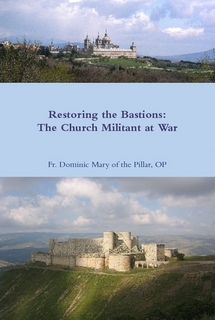
This week saw the publication of a book by this author: "Restoring the Bastions: The Church Militant at War". The hardback edition can be found at Lulu.com for 25.00, while a soft back edition may be purchased at createspace.com or Amazon.com.


26 November 2012

They Labour in Vain who Build It


"Unless the Lord build the house, they labour in vain that build it."

This verse of Psalm 126 should have been in the hearts and on the tongues of Catholics as the results of the last American presidential election began to flood into homes throughout the United States. Certainly the hopes of conservatives had taken a beating, as they saw that the candidate chosen by the Republican Party had been swept away by the forces of the New America and its poster boy, the incumbent Barack Obama. Surely grim faces met the morning light the following day, as the so-called conservatives found that the America that most voters believed in was not the America touted by Mitt Romney and Neo-Conservatism but the more forward America of Barack Obama.

This election is certainly a turning point in American politics. Some have pointed out that the present government, having become the source of income for millions of Americans who rely upon it for their daily bread, have in fact created an electorate that will not bite the hand that feeds it. Big government provides the bread and circuses that in turn provide a comfortable life to millions, and these beneficiaries will be the last to vote for any candidate that will withdraw the benefits they now enjoy, even if that means ignoring the abyss drawing ever nearer- a default on the increasing debt now in the trillions of dollars. Thus the Democrats are assured of ever greater power as the huddled masses longing to be fed and entertained increase in size and influence. But despite this unsettling fact, it must also be admitted that the Republicans are incapable of providing any real alternative. Even on the purely practical level, if the Republican Party lowered the amount of money spent on supporting those dependent upon government, its constant desire for more and more wars in the Middle East in order to bolster the power of the State of Israel would only end in increasing the debt of America, rather than lowering it. Its claim to moral superiority over the Obama regime fades therefore when American blood is pledged in unjust wars, and becomes indeed ludicrous when its touted stand against abortion is seen for what it is- only a pledge to restrict the murder of children to certain cases instead of all- not that that pledge would ever really be put into effect. What have Republicans learned out of this election? And what of those more conservative Catholics who have up to the present put their trust in that party and its supposed conservatism?

Republicans seem to now admit that there is a problem. Many, however, see this problem as the party being out of step with an America that is farther left socially. Their answer? Embrace the dream of social liberalism, while focusing on fiscal conservatism. In other words, embrace yesterday's dreams of the Democrats, while preaching a fiscal conservatism that piles on debt through military interventions in countries over which we are not sovereign. Not a very convincing plan if the idea is actually to be fiscally conservative.

The truly tragic part of this drama is not the frantic attempts to bring the Republicans "up to date." It is not even the fact that Obama won a second term in the White House. Those things are tragic enough, of course, but they are not at the heart of the tragedy. The true tragedy is being played out in the Catholic Church, among American Catholics in this case. Perhaps one can speak of a "Comico-Tragedy" as one studies the photo of Cardinal Dolan, Prince of the Church and head of the Archdiocese of New York, as he enjoys his guests at the Al Smith Dinner. On his left laughs the Republican candidate Romney, who gave his approval to a Health Care Law in Massachusetts that in no wise protected Catholic institutions from paying for contraceptives; on the other side was the laughing face of the pro-abortion, pro-contraceptive, pro-left Obama, no doubt enjoying the fact that Religion was certainly no obstacle to the Cardinal's invitation to dinner; while in the middle roared the Cardinal himself, making such a spectacle of himself that if one guest was noticeably absent, it was the decorum of a Prince of the Church. Would that the Cardinal had the dignity of an Irish peasant bowing before an English "milord" rather than the gracelessness of a buffoon in the court of liberal politics. When the election came round, it was plain to see that for the majority of bishops, there was no intention of really stopping the forces of secularism. They had grumbled loud enough to be noticed in Rome for their fidelity, but then had made sure that religion did not get in the way of a democratic victory. Not even all of this, however, was at the heart of the tragedy of 2012.

The real tragedy was the fact that no one questioned the underlying bases making this Obama victory possible. Non-Catholics, of course, had been carefully brought up in ignorance as to the lies underlying Republicanism and the Democrats, so an answer from them was hardly to be expected. But Catholics! Centuries of Catholic Christendom allowed the truth to reign in politics as in so many other areas where Christ was acknowledged as ruler over His creation. The Church has the answer and had condemned the madness that lies at the foundation of modern, liberal civilization, but its children from top to bottom in this age are immersed in the dream of an anti-Catholic liberalism. From the millions of Catholic in America, there has arisen no answer at all to the dilemma of the two headed serpent of Obama and Romney. Answers there are aplenty, all of them wrong. Conservative pundits pondered over how such a loss of Republican values was possible, politicians such as McCain pontificated on the need to be silent on such issues as abortion (it was not for him to be telling young women how to live their lives!), Romney reeled from the victory that he thought would surely be his, and was numb to any answers. For some, it was almost time to despair. Almost, but not quite. In this case, however, despair is precisely the beginning to an answer. It is an answer that is not new, nor is it to be invented by materialists or socialists. The answer was given two thousand years ago. It is the Catholic Faith, and the civilization that rises from it. Christ has given the only answer to man's difficulties. Every other answer is wrong and can only lead to destruction, as the 2012 election is a proof, and not the only one.

The Catholic Church alone has the answer, for it is God's own answer. Catholics must despair of the false answers of liberal protestantism or the "founding fathers" whose false dreams have led to the only end possible for falsehood: the fall of the West and the loss of sanity in matters even natural. We must despair of the entire American process given to us by heretics and unbelievers and return to the sanity of Catholic civilization. Christ must reign, or He will destroy us so as to make way for those who will obey His Law and His Gospel. "He MUST reign" says Sacred Scripture. It is not an option. Until Catholics say "no" to the entire system of Antichrist that has been built slowly but inexorably since the Reformation and even more so, since the founding of the New Atlantis, nothing will be solved. One must either submit oneself and ones nation to Christ the King, or be under the prince of this world. Tertia non datur.

29 October 2012

At the Escorial at last

It has only been a little over a week since this writer returned from a two week pilgrimage of sorts to the nation that best defended the Catholic Religion against the protestant attacks: the Kingdom of Spain. One can read about the role of this once great Catholic State and the many saints that thronged the monasteries, churches, and towns during Spain's golden age, and yet not quite realize the degree to which the sixteenth and seventeenth centuries were dominated by a power that was unabashedly Catholic. This was the situation of the present writer, who had read works on the figures of Spanish history without understanding concretely what the glory of Spain meant.

All started to become clear as the palace of El Escorial came into view. Here was an enormous complex, built around the great church of Saint Lawrence, and containing not only a palace for the king and the royal family, but also a monastery and school. It rose like a vision of the Jerusalem come down from above before the viewer, perched on the crest of a hill, overlooking a wide valley with forest and river, and having the mountains behind as a magnificent backdrop to the the center of the empire of Philip II and the Hapsburg kings. All of this handiwork was exquisite, both Divine and human. Yet grand as it was as a monument to royal power, one was struck still further by the Catholicism of the Spanish realm when one entered within. Room upon room contained masterpieces of art, the vast majority of which revealed some episode of sacred history. The patronage of the kings of Spain ensured that sacred revelation was clothed by the most talented masters of the artists world. But this was far from exhausting the mystery of the Escorial. All was built around the High Altar of the Church of Saint Lawrence. On one side was the small bedchamber of the king and the adjoining private study. The room of the king's repose was small, almost spartan; but it allowed the king to look upon the High Altar of the Church and so assist at the Mass, even if bedridden. On the other side of the altar was the Queen's chambers, constructed in the same manner. This was a Catholic king, and the Holy Sacrifice of the Mass was at the heart of Catholic Spain.

When one entered the basilica, one was struck by its magnificence. Side altar after side altar proclaimed devotion to the twelve apostles, and the saints of the Church through the ages found a place throughout the edifice. In the back was the Crucified, in Spanish style, suffering for mankind with all the intensity for which Spanish devotion was capable. But all moved to the High Altar, built at the climax of a myriad of steps, a true mountain of Sacrifice upon which Calvary was renewed. From this altar rose a high reredos, beautifully crafted with paintings proclaiming Catholic devotion. Here indeed was Catholicism proclaimed by the heroes of Spanish Christendom. The visitor could not help but be awed at the depth of the profession of the Catholic Faith, and the very symbolic grandeur by which it was professed by its mightiest defender.

It was kneeling before the High Altar of this temple of God, that this writer was struck the most forcefully by the glory that was Spain, a Catholic glory that was unashamed. The thought of a passage in "The Lord of the Rings" came spontaneously to mind. It might be objected that such a thought should have no place here in the palace of a great Catholic power, but the words describing Elven Lotholorien came to mind. That realm was said to be the "heart of elvendom upon earth". It was said in the midst of wonder. And so it was here. In the Escorial, one entered not only into a Church that boldly proclaimed the truth of Catholicism. One entered into a church around which the greatest empire in Europe was governed, but which was the devotional heart of the kings of that empire. Here was the temporal heart of Christendom upon earth, even as Rome was its spiritual heart. Spain may have been slowly destroyed by its non-Catholic enemies, ideologically and religiously, but this palace still triumphantly stood as a monument to better times. Even now, the black legend is the backdrop to world history as presently taught. The figures of Isabella the Catholic and Philip II are paraded as the nadir of fanaticism and intolerance. But this is appropriate as the King of Kings and Lord of Lords was mocked by the figures surrounding the apostate figure of the High Priest of Israel, His mission derided by the very people He came to save. So the western world mocks the memory of Catholic Spain. Its kings are derided for intolerance, its Inquisition that saved that kingdom from the religious wars afflicting Europe is the quintessence of evil in the eyes of a world that does not blink at the murder of millions of its offspring, nor at the fact that it has caused the death of millions more during the course of two world wars. All in the name of democracy and the liberty of man.

And so the Escorial stands still. In its bosom lie the mortal remains of the Spanish monarchs since Charles V, save for two, their queens, infantas, and the monument of Don Juan of Austria, half-brother to Philip II and hero of Lepanto. Let the degraded descendants of the mighty kingdom of Spain spurn the greatness of their ancestors, let the tourists gawk at the vast palace from which Spain ruled the world. None of this will detract from the monument to the great deeds of Spain's past and the sacrifice of its blood to preserve the Catholic religion and spread it throughout the Spanish empire. That is a crown that can never be taken away, a crown laid up for Catholic Spain in Heaven.